History & Significance
With golf being reportedly played on this piece of land since the 16th century, and the course being touched by both Old Tom Morris and James Braid, this is definitely considered one of the more historical significant courses to play, with 8 Open’s played there, the most recent one in 2018 but the probably the most memorable one back in 1999 featuring the meltdown of Jean van de Velde.
The Destination
Carnoustie is often cited as the “working man’s course”, and that identity is prevalent from the second you get off the train pulling into Carnoustie rail station. After 7 hours and 2 changes we finally arrived on the platform at some time after 10pm, and we would be excused for thinking we had missed our stop and ended up in some remote part of Northern Scotland that we will need to wait for 2 days to get a train back, rather than one of the most historic golfing destinations. We walked out of the station with no phone signal, and figured best course of action is to just to go down towards the road that runs along-side the sea and go from there. We looked left and right, and the only thing that made our decision was one way had a small light that seemed several miles away. This turned out to be the Carnoustie hotel. We settled in only to wake up to a blue sky beaming down on the course without a cloud in sight. I have played just under 10 rounds of golf in Scotland in my life, and to this day have not had a drop of rain, a lucky streak I am sure is going to end very very soon.
The Course Itself
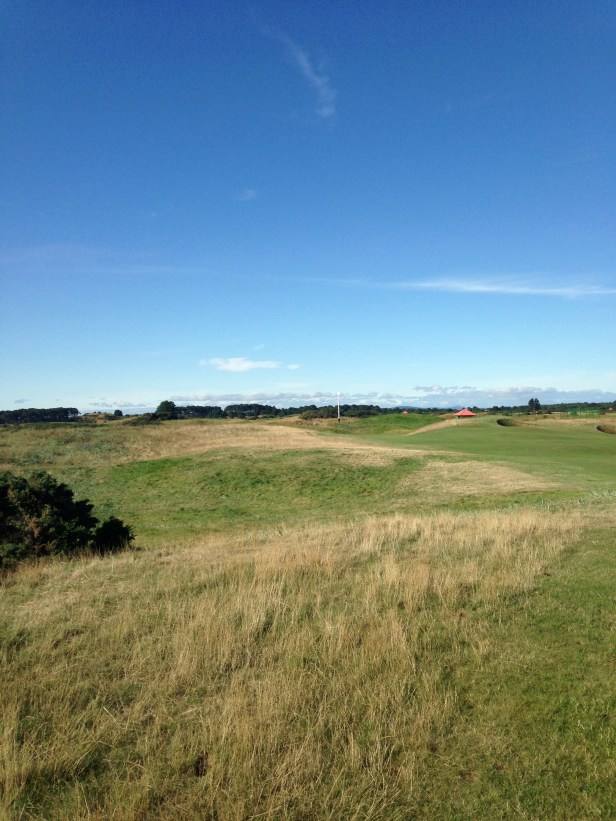
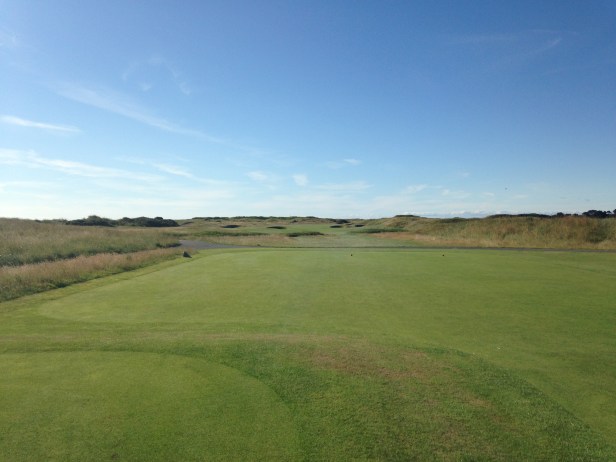
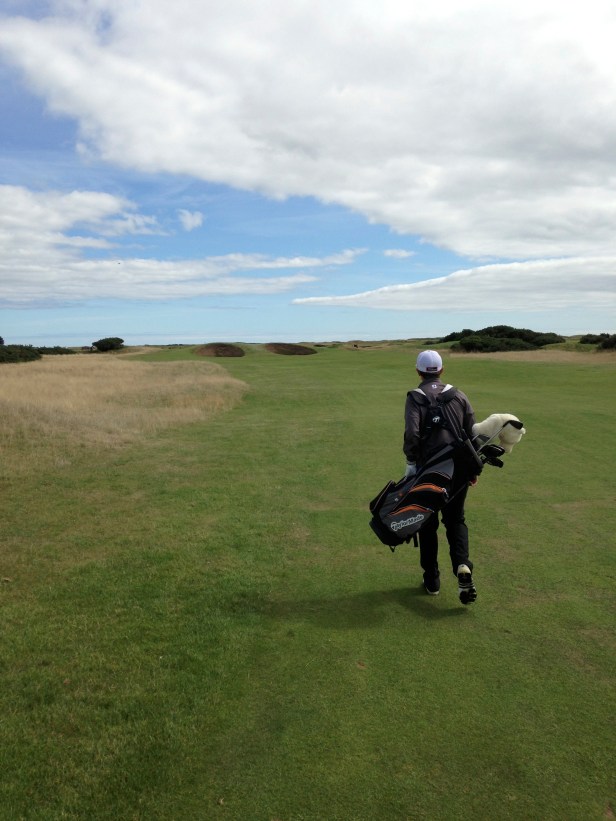
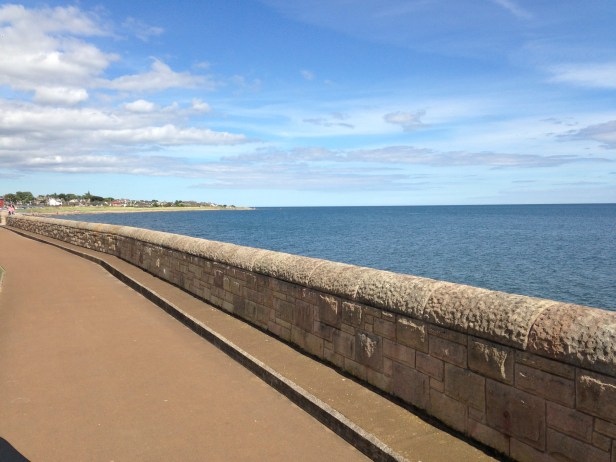
The first thing to say, and something that probably sums up the course very well in a nutshell, is that I wish I can go play the course again as a better golfer. I play to a 16 handicap, and as all mid teen handicappers know, there can be wild swings around that number. I like to think of the great golfing experiences as having at least one (but hopefully more than one) of the following: great natural beauty/drama, historic significance, and being an excellent test of golf. The first two criteria are relatively obvious. The third one is a bit harder to describe but ultimately comes down to hard did you have to think while you played the course. A great test of golf is when the round took longer than usual simply because of the fact there were a lot of decision to make along the way. This is what I think really separates the great architects. Carnoustie obviously has a huge amount of historical significance, but it is truly a difficult course that pushes you to the limit. At every point, you can tell that testing a golfers ability supersedes all other objectives. The course sits on the coast, yet there are zero water views, and really for the 95% of your time in Carnoustie you won’t even notice that there is water nearby aside from the wind and sound of seagulls. Enjoy the water views while you walk back and forth to the hotel. Ultimately the course’s difficulty lies in the usual Scottish links suspects: constant potential for changing winds, firm ground that makes the ball roll for an eternity with bunkers functioning like magnets, and large multi-layered greens. What adds another layer of difficulty is the burn that snakes its way through the course, putting a premium on accuracy.
The finishing three holes are visually extremely daunting, where it is hard to even figure out where you are supposed to hit the ball (especially on the 17th). We even had to take a step back to make sure we took it all in, rather than continued to be immersed in the Rubik’s cube that is Carnoustie.
Ultimately, I have to admit I was not a good enough golfer (either on the day or in general) when I played the course, and therefore I know that I didn’t get as much out of the course as I should have. It is a course where your enjoyment increases exponential with skill level, and so I am definitely going to have another stab at it if I get to sub 10 handicap.
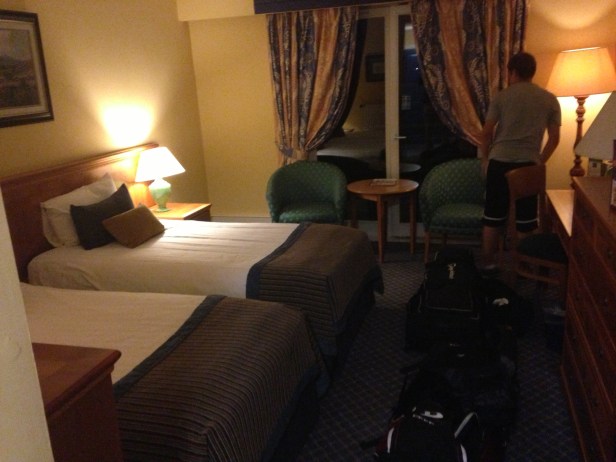
Our room at the Carnoustie hotel:
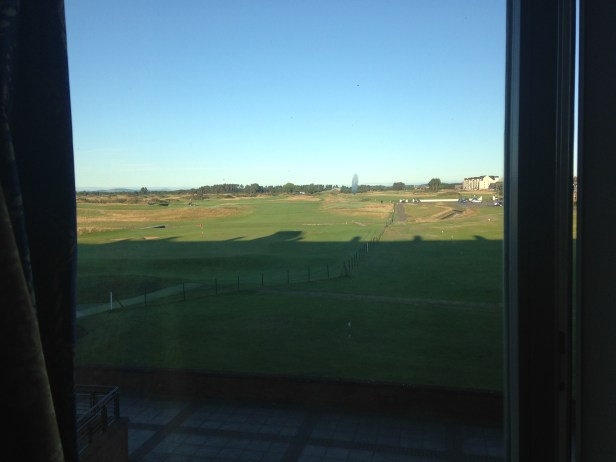
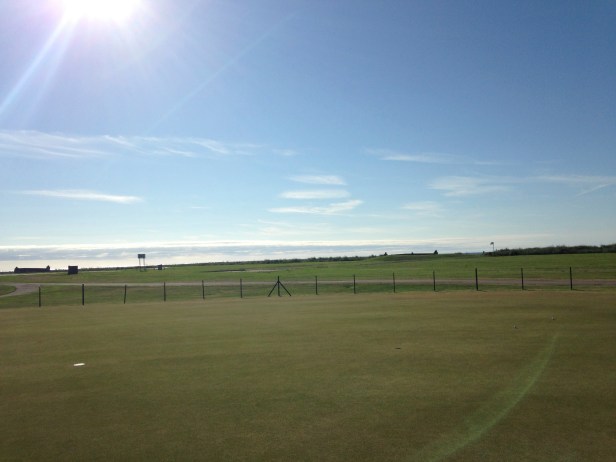
Little did we realize the view we would have the very next morning without a cloud in sight:



 A Golf Odyssey